Can You Trust AI’s Reasoning?
Written by The Count Team

Confident AI answers can hide flawed logic. Learn how Count’s Reasoning Chains trace claims to sources, assumptions and calculations so you can spot errors before trusting conclusions.
You cannot trust AI’s reasoning from a confident answer or fluent explanation alone. Trust requires checking whether each important claim traces to valid sources, declared assumptions and logic that supports the conclusion. AI can use correct facts and still fail through overclaiming, bad denominators, omitted evidence or inconsistent rules.
This matters for analysts, researchers and other knowledge workers using AI to support decisions. A traceable methodology lets them find load-bearing problems without manually reviewing every tool call, calculation and source.
Why isn’t factual accuracy enough to trust AI?
Factual accuracy is only one part of a reliable AI answer because the conclusion can still rest on weak reasoning. Hallucinations include recognisable errors such as a fabricated fact or an incorrect number. Reasoning failures are often less obvious.
An AI might generalise from three sales calls to all customers. It might ignore a source that contradicts its conclusion. It might use the wrong population when calculating a percentage. None of those failures necessarily looks absurd when presented in a polished summary.
Outright fabrication can be less common with frontier models, but subtle methodological problems remain. Those problems can be load-bearing for the final recommendation.
What did the blue-green test reveal about AI reasoning?
The blue-green test showed that Claude could state a rule and contradict that rule within the same response. The question was subjective, but Claude often presented its answer as though a precise boundary could resolve it.
Alice Ferrier asked Claude 100 times where blue becomes green. Claude usually selected a hue value between about 165 and 180. It often described 180 as the official boundary before choosing a different cutoff based on what it claimed to perceive.
Some responses then applied their own cutoff inconsistently. Claude could set a boundary near 170 and make a claim about turquoise at hue 174 that did not follow from the rule it had just given.
The underlying human survey contained roughly three million colour-naming responses. A separate analysis problem appeared when the agent combined the full survey with a smaller sample taken from that same survey. That calculation produced a boundary of 168.5 by pooling overlapping data. Tracing the number back through the analysis exposed the problem.
Can ChatGPT or Claude check its own answer?
Asking ChatGPT or Claude to confirm its own answer is not independent verification. The model can repeat the same assumption, preserve the same logical error or produce another persuasive explanation.
Every leader in the survey discussed in the video had encountered an AI error or hallucination. Common checks still relied on gut feel or asking the AI whether it was correct.
Domain expertise helps, but it does not remove the risk. Research from Anthropic discussed in the video suggests that even experts can be influenced by an authoritative AI argument.
What should you check before trusting an AI answer?
A useful AI review checks the evidence and methodology behind every claim that could change the conclusion.
Look for the following problems.
- The cited source does not exist or does not support the claim.
- An important assumption has not been stated.
- The conclusion is broader than the evidence allows.
- A source contradicts the conclusion but is not acknowledged.
- A percentage uses the wrong denominator or population.
- A filter, join or calculation changes the meaning of the data.
- A written summary refers to an older version of a chart or calculation.
- Live data has changed while the surrounding commentary remains static.
The goal is not to review every step with equal effort. The goal is to identify the claims and assumptions that carry the argument.
How do Count’s Reasoning Chains work?
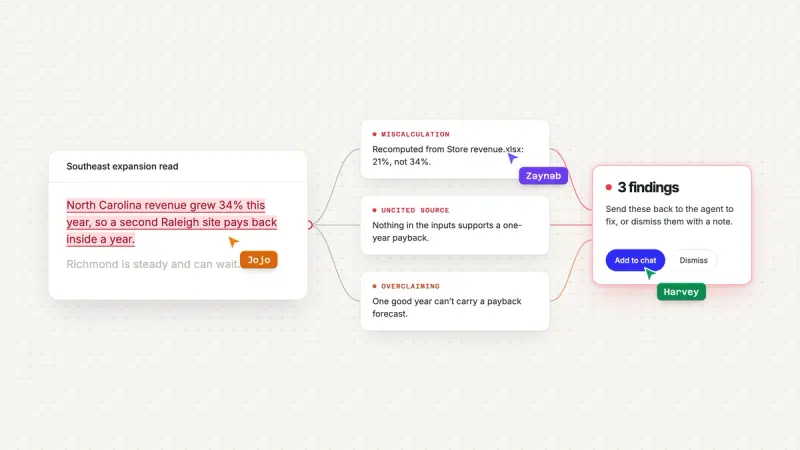
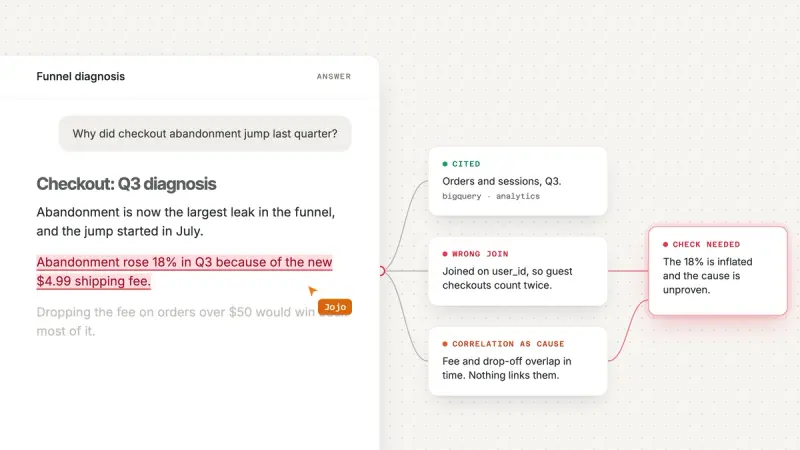
Count’s Reasoning Chains let a user click a claim and trace it through supporting evidence, assumptions, calculations and logical dependencies. The chain can include written sources, database cells, SQL, Python and other claims.
Count first requires citations by reference and checks that each cited item exists. The agent then makes the argument behind the output explicit. A separate model reviews the question, inputs, answer and reasoning chain for issues that could affect the conclusion.
The review is designed to direct attention to substantive problems rather than cover the canvas in minor technical warnings. Count’s taxonomy was informed by ICD 203, the analytic standards created by the US intelligence community following intelligence failures around the Iraq war.
Are Reasoning Chains the same as chain of thought?
Reasoning Chains are not the same as a model’s chain of thought. They provide a visible lineage from an output to the sources, assumptions and logical steps needed to support it.
The distinction matters because an explanation can sound convincing without faithfully accounting for the answer. A checkable chain breaks the argument into smaller claims that a person can inspect individually.
What kinds of AI errors can reasoning chains find?
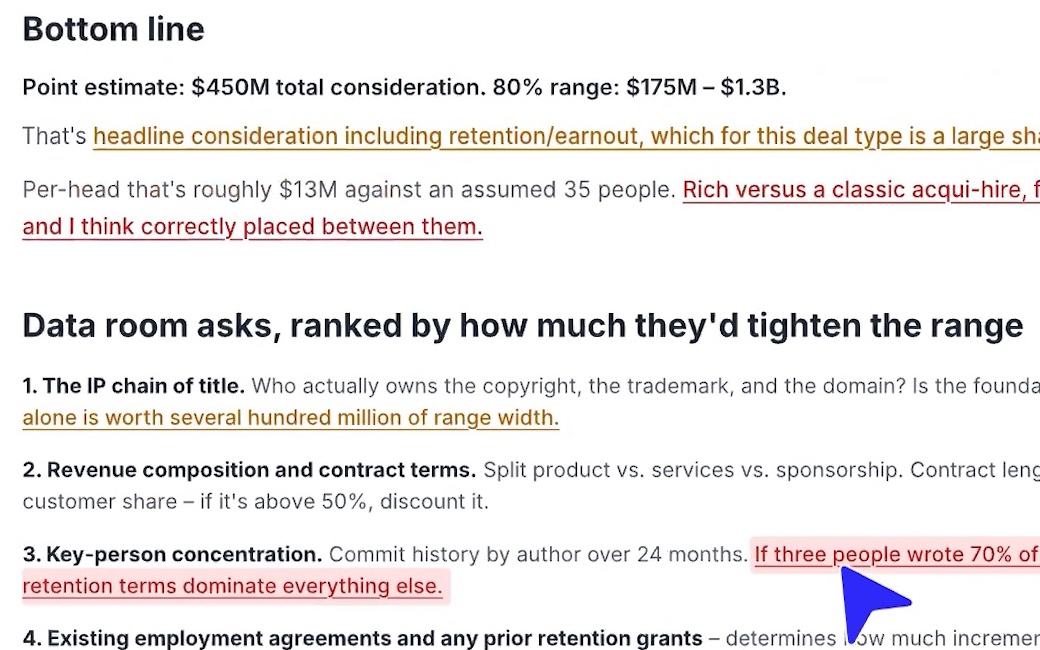
Reasoning chains can reveal factual errors, overclaims, hidden assumptions, contradictory evidence and methodological mistakes. They can also expose problems created as an analysis changes over time.
In the colour analysis, the review flagged assumptions about fixed colour boundaries and whether a user ID represented one person. It also found summaries that had not been updated after calculations changed. The overlapping survey data showed how a plausible number could depend on an invalid method.
Not every flagged assumption is wrong. Some assumptions are reasonable and simply need to be visible so the reviewer can decide whether they are suitable for the decision.
How can tracing AI reasoning improve future answers?
Tracing AI reasoning reveals where an agent lacks the context needed to answer consistently. If an agent has to invent a metric definition, the chain makes that assumption visible.
Teams can use those findings to add missing definitions, resolve conflicting instructions and improve the context available to the agent. They can then inspect later chains to see whether the revised context is being used.
What should you do next?
Start with one load-bearing claim in an AI-generated analysis and trace its source, assumptions and calculations before accepting the conclusion. The video Can You Trust AI’s Reasoning? Tracing False Claims with Reasoning Chains contains the worked blue-green example and shows how its hidden contradictions and analysis errors were found.