What are Reasoning Chains?
Written by Oliver Hughes
Oliver Hughes explains how Reasoning Chains make AI outputs transparent, auditable and trustworthy by exposing assumptions, sources and logic.
Reasoning Chains are a new technology developed at Count to help make AI’s answers understandable, auditable and trustworthy.
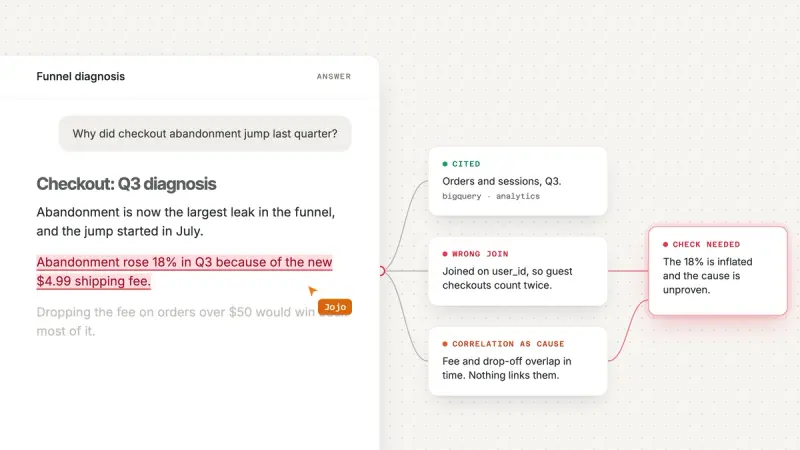
Not to be confused with a model’s chain of thought, Reasoning Chains turn every claim an AI makes into a structured, logical argument that includes all assumptions, methodological steps and sources so humans and agents can review and interrogate them.
In this blog post I’ll explain how they work, the problems they can identify and why we believe Reasoning Chains are a fundamental building block for AI-driven knowledge work.
The problem of trust
Trust remains a huge problem for organizations trying to leverage the power of AI. In our recent survey of 93 (Wynter, July 2026) SaaS executives 81% said that trust and output quality was their biggest pain point when trying to adopt AI.
Reducing hallucinations has been a focus of model providers and organizations alike. Wrong answers and made-up facts remain a blocker increasingly autonomous agents and more productive knowledge workers because the cost of a poor decision can be high.
Organizations are spending huge amounts of effort building better skills and context so agents are more likely to get things right. But hallucinations remain and, as we all know, can be incredibly hard to spot.

To put some numbers to this, we surveyed a further 30 SaaS sales and product leaders (Wynter, August 2026). All 30 had found hallucinations in the previous three months, and 40% reported seeing them weekly. More worryingly, only 9 of the 30 were confident they could spot hallucinations reliably, relying primarily on their own domain knowledge to check.
So despite all the latest model improvements and better context, hallucinations are still an every-day cost of working with AI and almost certainly no one is finding them all…
No wonder trust is a big problem.
Hallucinations are not the biggest problem
Trust is more than about accuracy. You can have all the right facts and still come up with the wrong conclusions.
Critical thinking and reasoning (in the sense of building logical arguments) matter just as much when you’re making decisions. Our analysis suggests methodological errors, such as poor assumptions, overconfidence, over-claiming or simply forming an illogical argument, are 13 times more common than outright hallucinations. And, most worryingly, these errors are generally harder to spot.
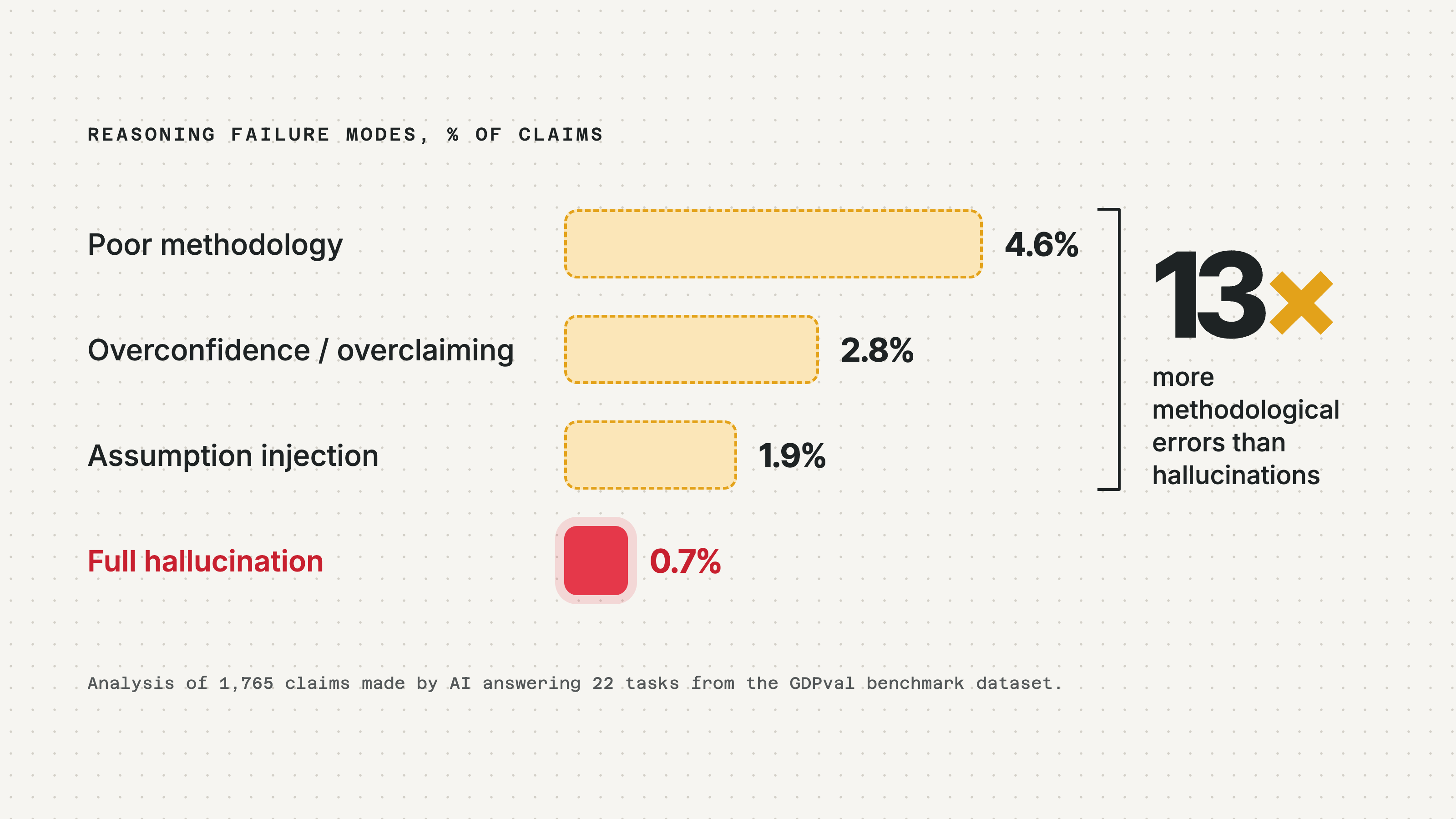
This is the bigger challenge if we want to rely on AI’s answers for meaningful “bet the house” decisions or even just to feel confident when your sending work to your boss.
To do this we need transparent methodology so we can understand and critique how an answer is made not just the answer itself.
An analogy from coding
I would argue transparency is one of the reasons AI has exploded so much more in coding than other areas to date. The nature of code is that the final result (the product/feature) is packaged with the code that makes it (the methodology). This gives you something concrete to inspect and test, either by checking the final product/feature works as intended or by reviewing the code or both.
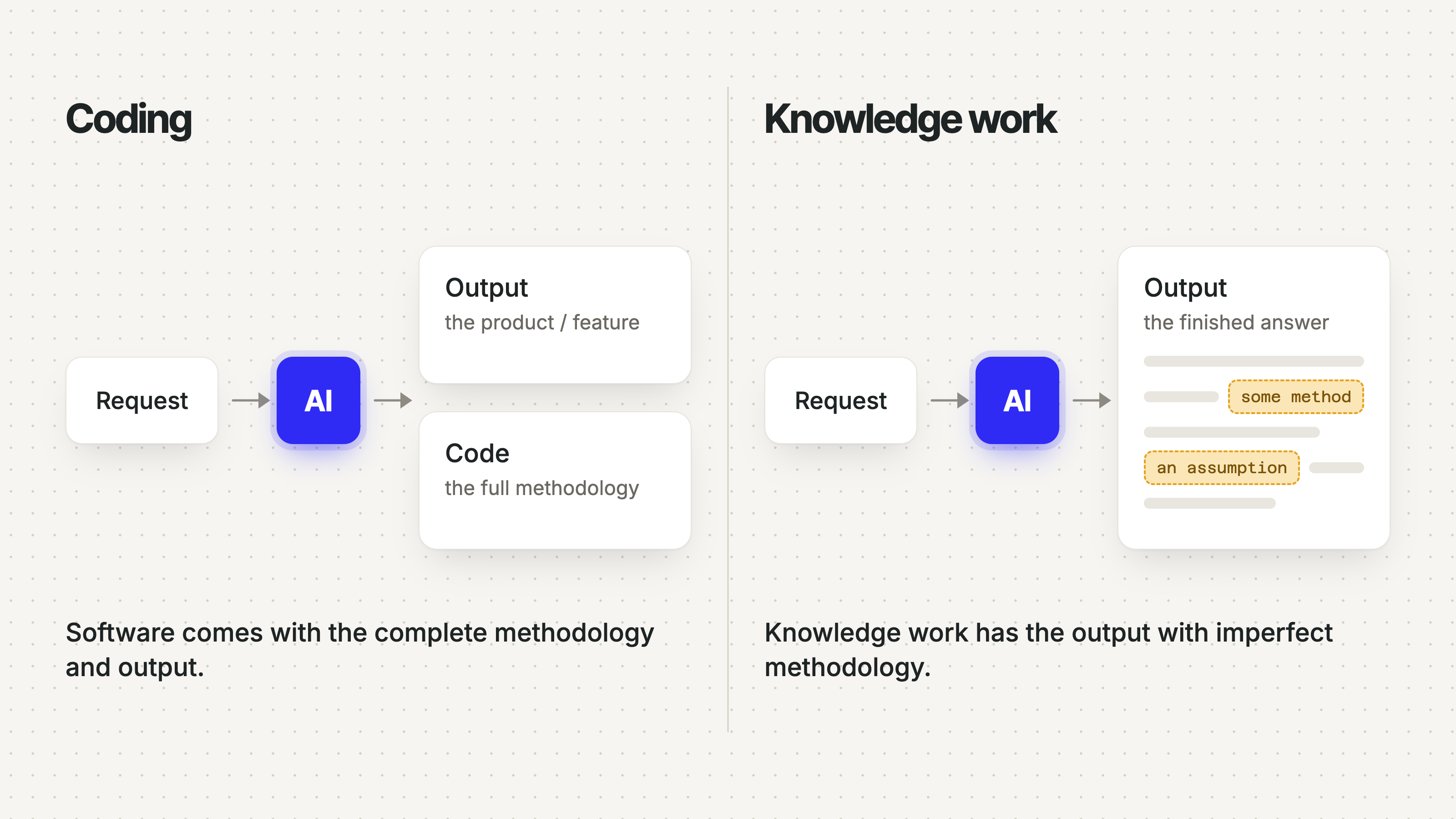
The same level of transparency is harder to achieve in knowledge work. An AI typically gives you only the finished answer. It may explain parts of its methodology, but much of the supporting logic is left out to keep the output readable.
This was already a problem before AI. We often relied on the author’s credibility when assessing any analysis or research whether through a direct relationship, their track record or a McKinsey badge in the corner. With AI, that basis for trust is missing.
If we believe this analogy holds then what is needed for AI to build reliable, trustable knowledge is “the code of knowledge work”. A way to inspect the methodology alongside the output.
Reasoning Chains fill in the blackbox
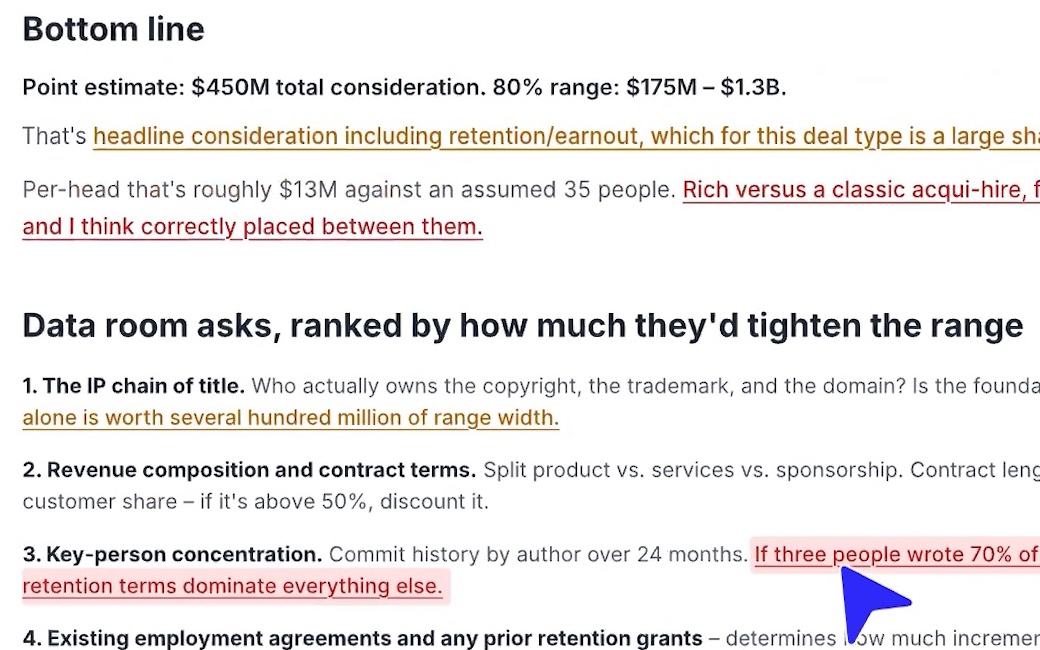
Reasoning chains aim to fill this gap by providing a clear methodological providence between every single claim in an AI’s output and its inputs. They include every assumption, inference and source so that every fact can be audited, checked and understood by users or agent.
Breaking down work into logical steps provides a number of benefits:
1) Clear methodology: As discussed above the most obvious benefit of Reasoning Chains is they provide a methodological artifact which end users can use to validate any claim is trustworthy and load bearing. Critical, but previously hidden, assumptions or methodological choices - though not necessarily wrong - become visible and verified before a decision is made.
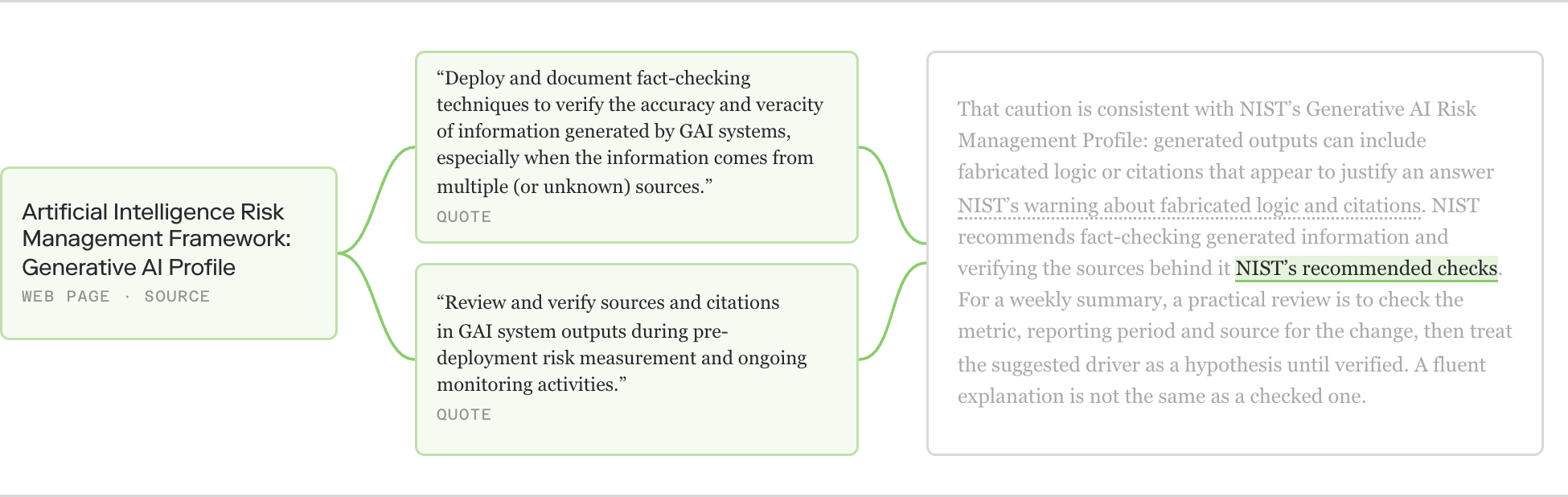
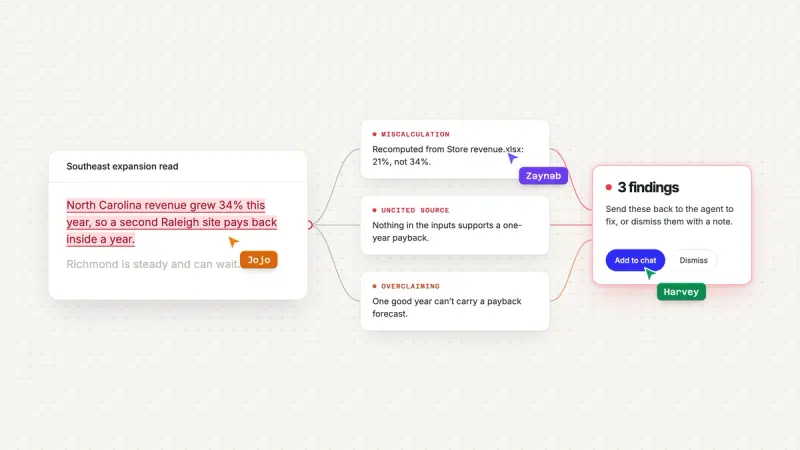
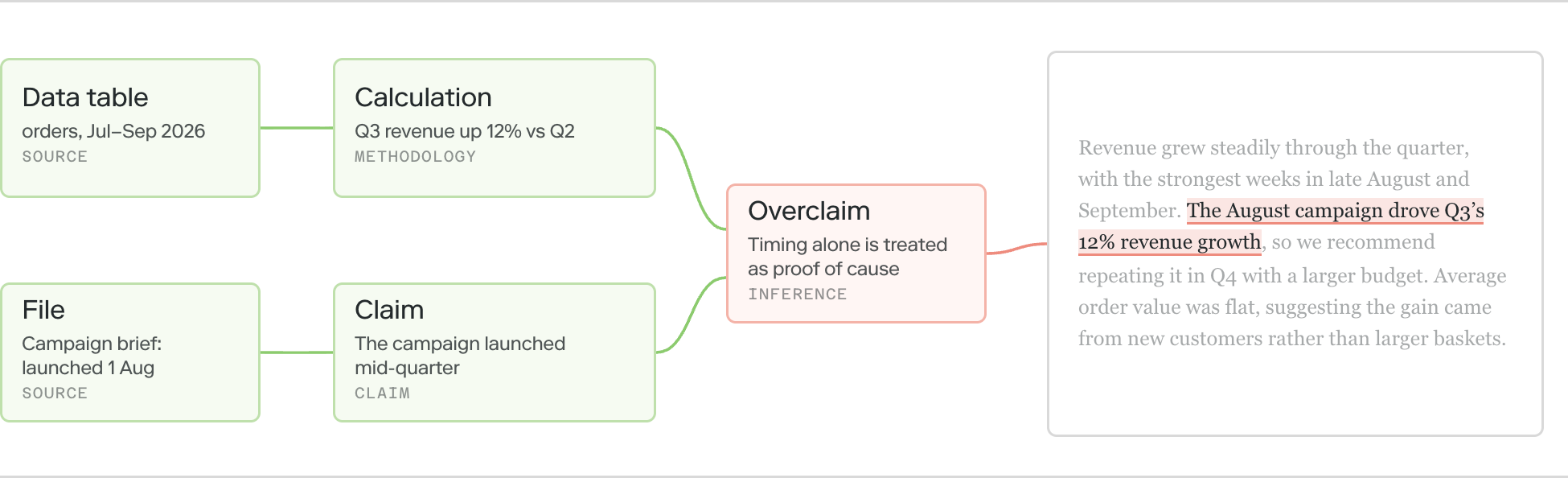
2) Hallucination and error detection: Once the argument is explicit, potential errors become easier to uncover. A fact or quote may have no source (a hallucination), or be calculated wrong or a conclusion may overstate what the evidence shows. Reasoning Chains can help expose ways an output is wrong or could be improved.
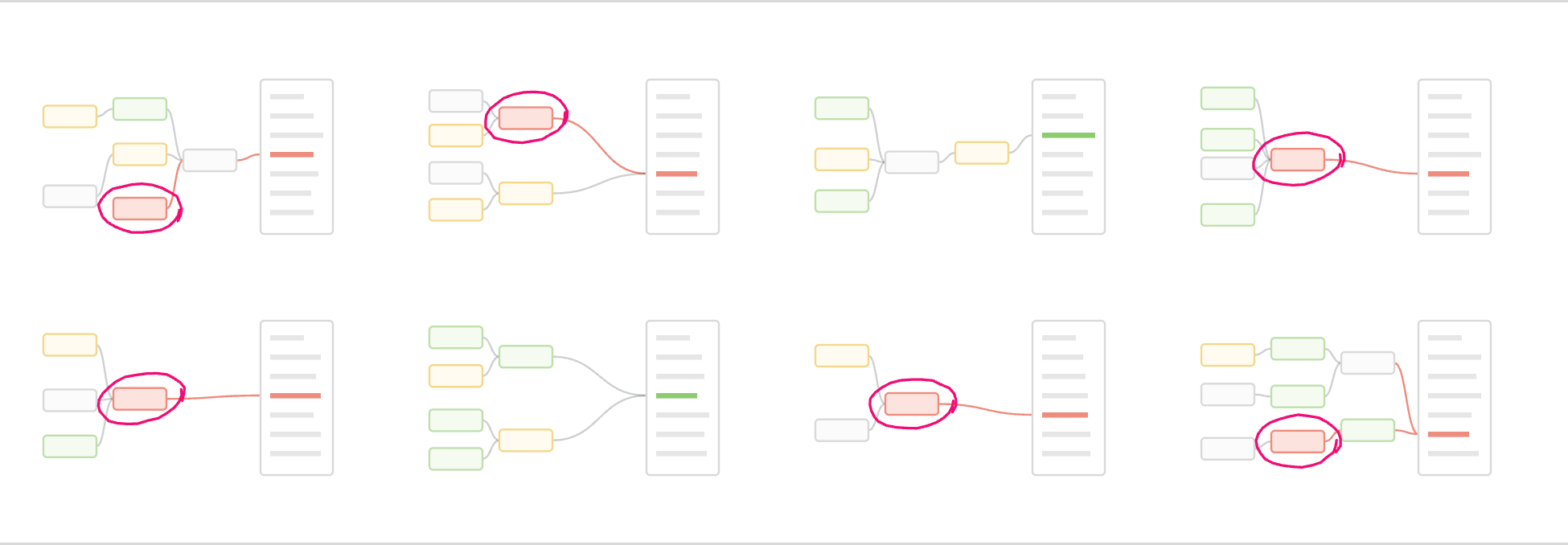
3) Improving agents over time: Analysing Reasoning Chains at scale helps reveal recurring problems: the same unsupported assumption, gaps in supporting evidence or weak inferences appearing across different answers. These patterns can guide changes to an agent’s skills, context or instructions and help you assess whether those changes improve its outputs.
See Reasoning Chains in action for research, data analysis, content creation, and more on another recent blog post.
What reasoning chains are not
There are lots of buzzwords around AI, and the subtleties can get lost. Sometimes it’s helpful to explain something by saying what it is not:
- Reasoning Chains are not a model’s chain of thought. They aren’t created from its chain of thought either. As has been documented by many of the model providers chain of thought tokens can be misleading.
- Reasoning Chains are not actually how the LLM “thinks”. Instead they are a logical representation of how the output could be rebuilt. There’s a useful parallel here with how humans work: the way we carry out a task often differs from how we explain it clearly to someone else.
We believe Reasoning Chains are a fundamental building block for AI-driven knowledge work. If we’re going to rely on AI for important decisions, we need to be able to check the argument behind an answer: what supports it, what it assumes and whether its conclusions follow.
There’s lots more we’ll be sharing about Reasoning Chains in the coming weeks and months. In the meantime, you can try them in Count, and we’d love to hear what you think.