The hidden cost of AI hallucinations
Written by Mitra Abrahams
Mitra Abrahams explains the hidden cost of AI hallucinations—and why subtle reasoning errors undermine trust, drain productivity and put business decisions at risk.
TL;DR:
- 81% of execs we surveyed called trust in AI outputs out as their biggest pain point (against 33% for context/skills).
- 100% of the senior leaders we surveyed had caught an AI hallucination in business work in the last three months; 40% see them weekly.
- Most hallucinations aren't the "fake data" kind. In our own review of 1,765 claims across 198 real assessments, just 0.7% were outright invented. 26% had a hidden reasoning failure instead: real evidence, badly used.
- Reviewing and verifying AI outputs takes time. Back of envelope - a cost of roughly £4k per employee per year - for the ones that get spotted.
- Only 30% of people feel confident they'd reliably spot a hallucination - and a missed one could have real consequences.
Trust is the bottleneck, not skills
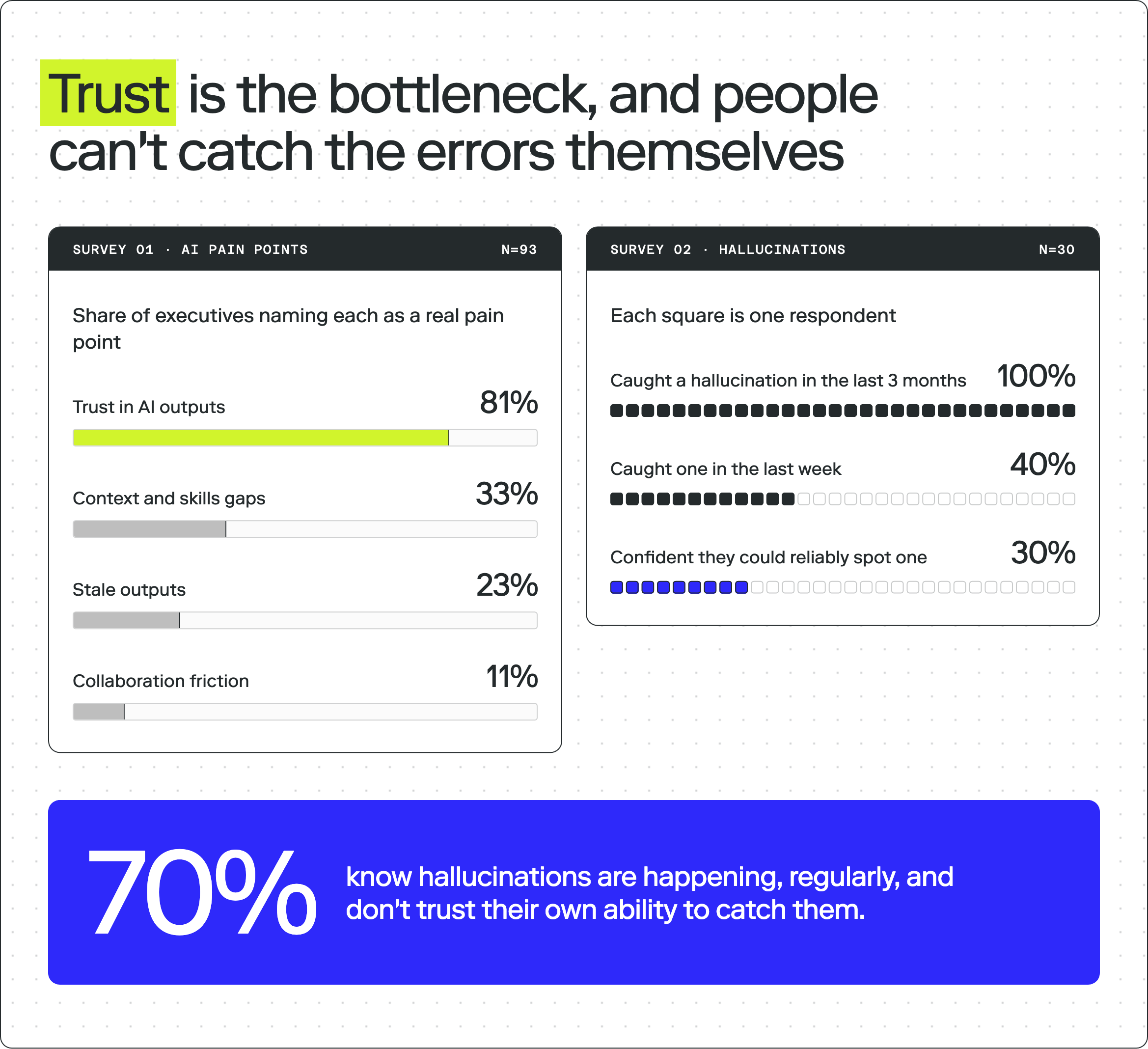
Ask executives what's standing between them and more value from AI, and the answer isn't what most AI vendors are selling. In our survey of 93 execs, 81% named trust in AI outputs as a real pain point. Context and skills gaps came a distant second at 33%, stale outputs at 23%, collaboration friction at 11%.
But most of the industry is still selling better prompts, better copilots, better integrations... all of which assume the bottleneck is capability. It isn't. The bottleneck is that people don't trust what comes out the other end enough to act on it without re-checking it themselves, which quietly erases most of the time saved in the first place. It's the same trust gap I've written about before, just with a number attached.
Everyone's seen an AI hallucination. Nobody's sure they'd catch the next one.
We ran a separate survey of 30 senior knowledge workers. Every single one had personally caught an AI hallucination in business work in the last three months. 40% had caught one in the last week.
Only 30% said they're confident they could reliably spot one. The other 70% know it's happening, regularly, and don't trust their own ability to catch it. That's not a skills gap you just close with a training session but a structural problem with how AI output gets reviewed, or doesn't — the same confidence bubble we keep hearing about from product and exec teams.
The fake-data hallucination is the easy 1%
When people picture an AI hallucination, they picture a made-up statistic or a citation that doesn't exist. Fair enough, that happens, but it's the obvious and the easy case: you spot it, you check it, it's wrong, done.
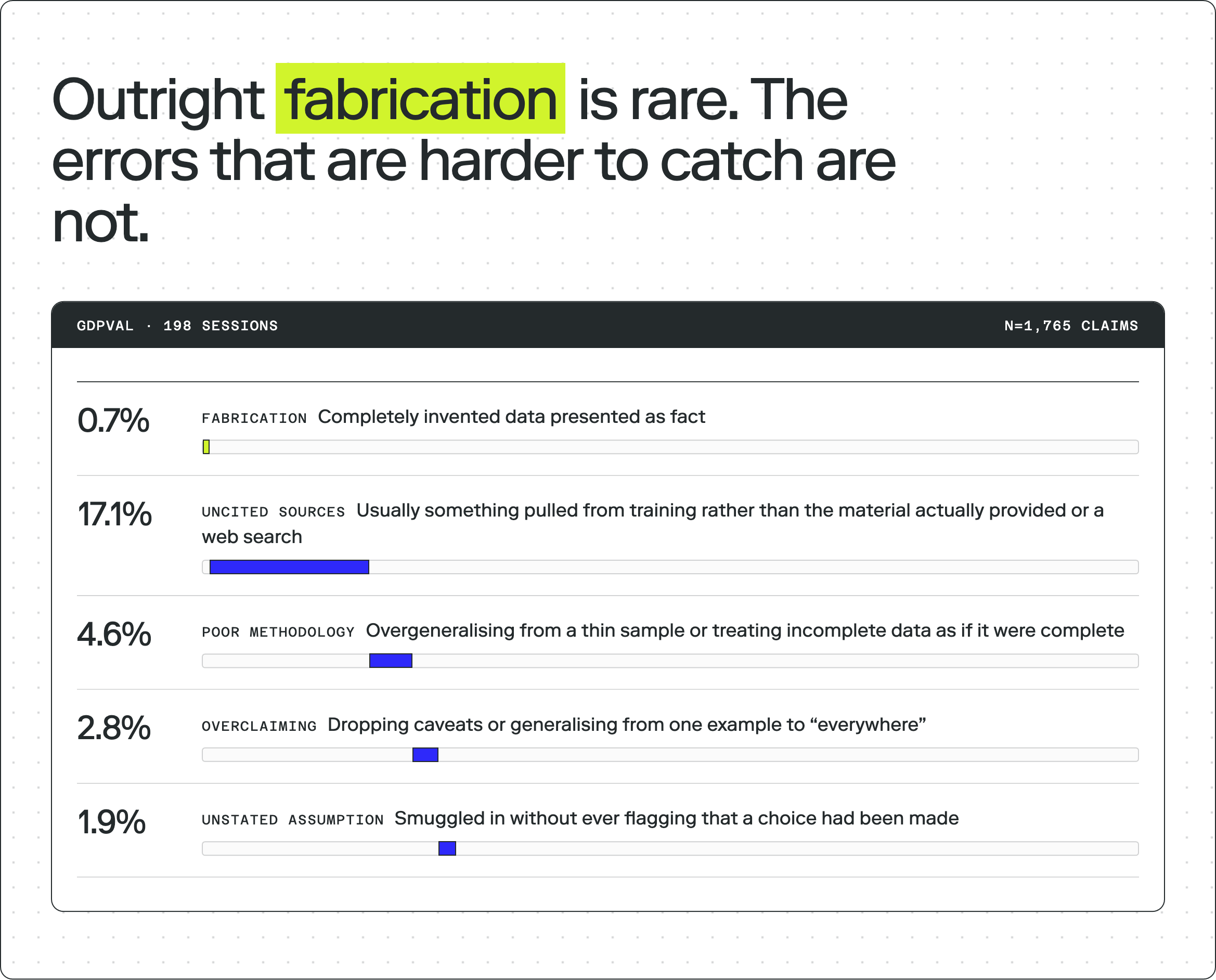
But across 1,765 claims (spanning 198 sessions of the GDPVal real-world, knowledge-work tasks), outright fabrication, completely invented data presented as fact, showed up in just 0.7% of claims.
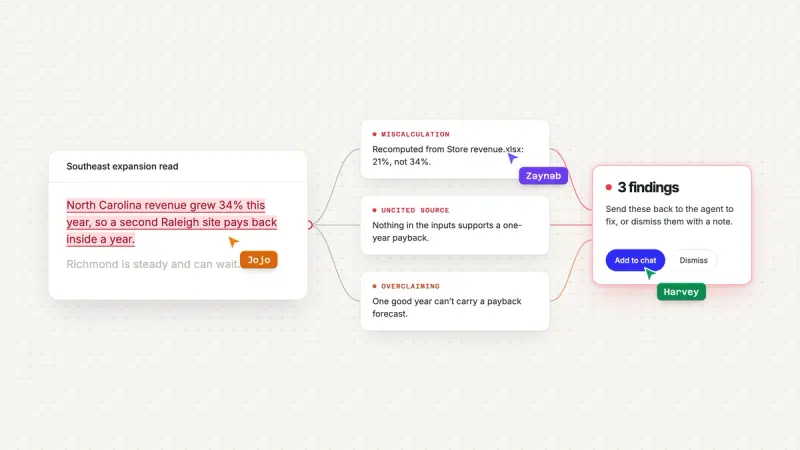
What shows up instead (26% of the time) was harder to name and much harder to catch:
- 17.1% relied on uncited sources, usually something pulled from training rather than the material actually provided or a web search
- 4.6% showed poor methodology, overgeneralising from a thin sample or treating incomplete data as if it were complete
- 2.8% overclaimed, dropping caveats or generalising from one example to "everywhere"
- 1.9% smuggled in an unstated assumption without ever flagging that a choice had been made
None of that is fabrication. Every individual fact in those claims can check out, what we've called a house of cards hallucination before. The conclusion is still wrong, and there's no single false statement to point at, which is exactly why it gets waved through.
What that actually costs
We will get to the big numbers in a bit. But this must be costing us, right? Time to review AI outputs costs. Fixing errors in AI outputs costs. Not spotting the errors at all...
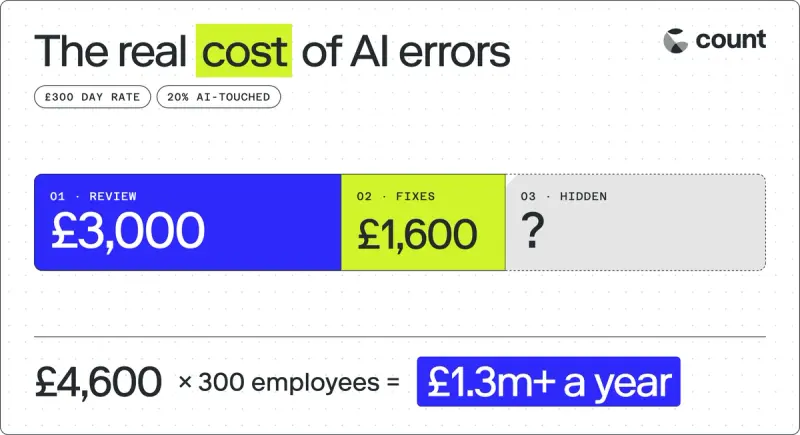
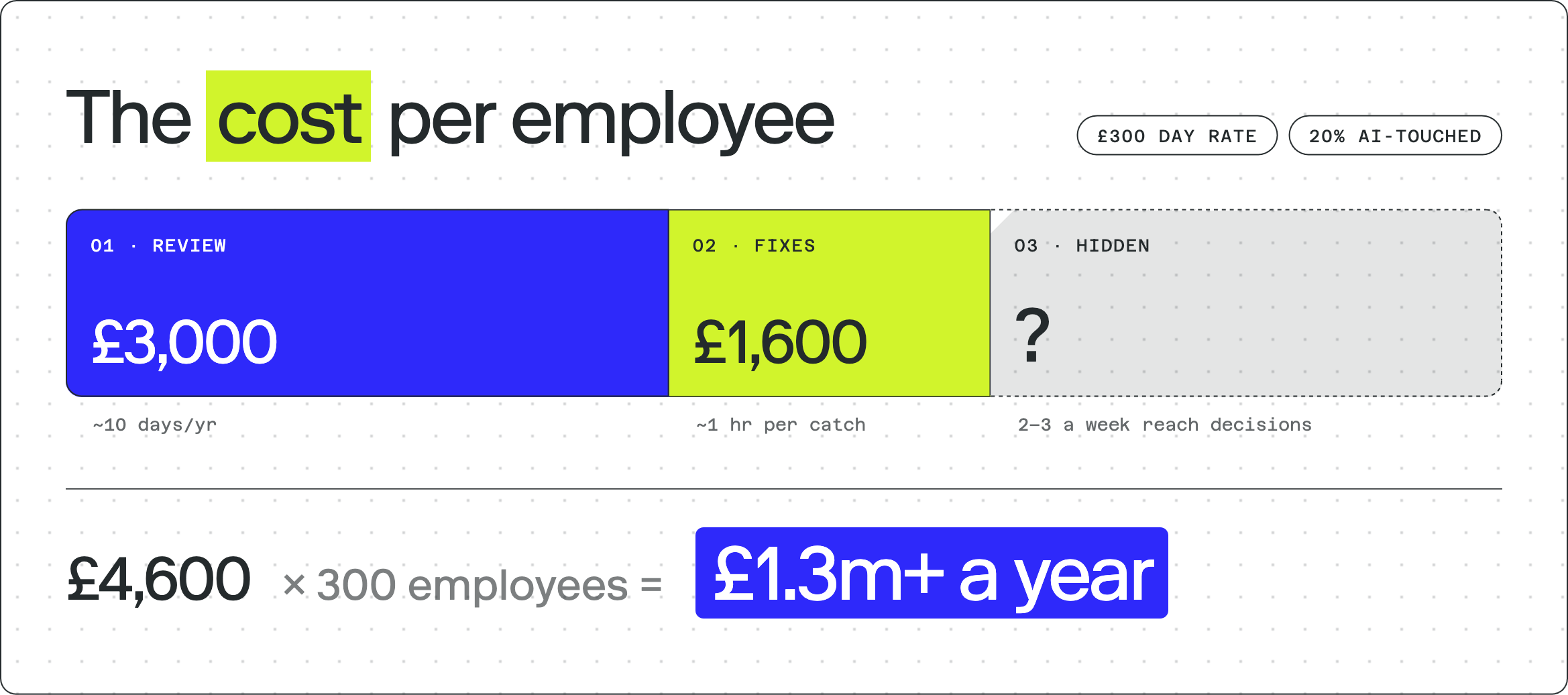
Here's a back-of-envelope version. Let's take an employee on a £300 day rate, and say AI touches about 20% of their work. Here are the 3 big ways that's costing your business:
1. The on-going review cost. You can't selectively check just the risky-looking outputs, not with a 70% confidence gap like the one above, so scrutiny has to apply across the board. Call it 20% extra review time on top of that AI-touched day: roughly 10 extra days a year, around £3,000 per employee. And it's often not the person who generated the output doing that reviewing, it gets pushed to a data team or a senior leader instead, whose day rate is usually higher than the original employee's. That makes this a floor, not a ceiling.
2. The spotted failure cost. In our survey of 30 senior knowledge workers, 42% described a real but minor failure they'd caught, 42% described a moderate one, and 15% described a major failure requiring several hours of work to resolve. Let's say fixing those takes roughly 10 minutes, 1 hour, and half a day respectively - a blended average of an hour per failure. In our survey 77% of respondents caught an error per week or more, so that's £1,600 per employee per year, just in time spent fixing those errors that you can spot.
3. The hidden failure cost. This is the one that doesn't show up anywhere, because it's not caught. If people are spotting 1 or more failure a week, and <1% of claims show such hallucinations then there might be as many as 26 more subtle, hidden, reasoning failures per week too! But, to be a bit more optimistic, let's assume only a fraction of those actually lead to flawed decisions that make it through the system - say, 10%. That still leaves roughly 2-3 hidden failures per week that could impact real decisions. The cost of addressing these failure is kind of unlimited (but see Deloitte Australia's and EY Canada's experiences as an upper end).
Add the first two up and you're already paying £4,600 per employee per year, for a 300-person company, that's over £1.3m a year. For some companies, this cost is well below the value they get from improved productivity - but for many companies this number is a cost they could do without.
The cost nobody wants to face
The hidden failure cost is the one that really gets you. It's not just about the time spent fixing errors you can see; it's about the decisions that go wrong because the errors you can't see slipped through. This is the cost that could cost a bomb. Could cost your reputation. Could cost your business.
If only 30% of people think they can spot hallucinations and if the majority of hallucinations are actually subtle, hidden reasoning failures. Do you trust your team to catch them all?
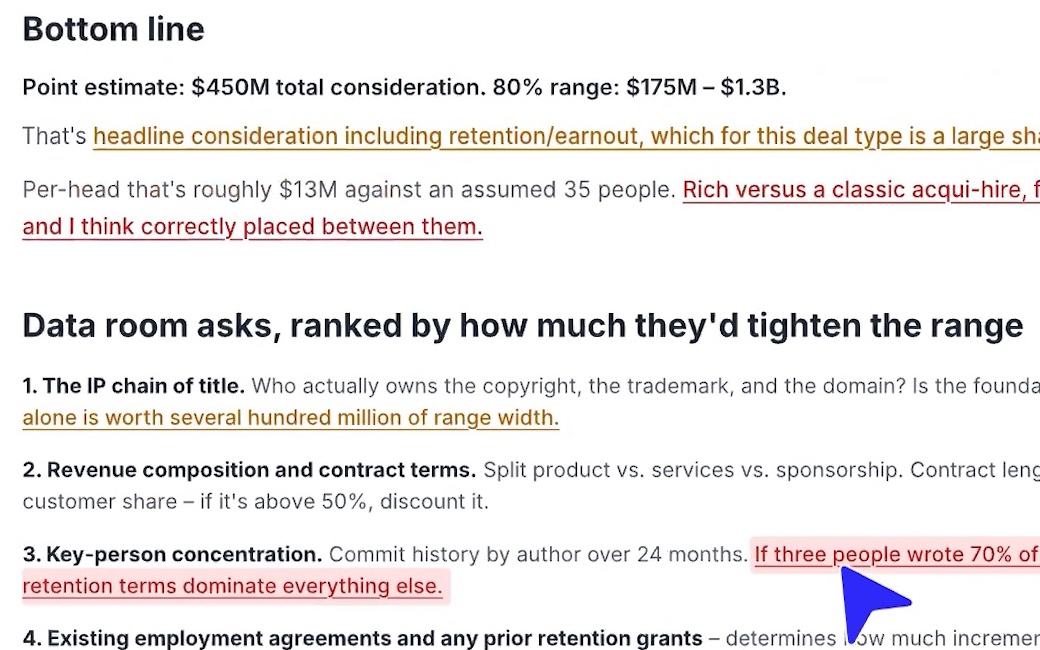
Count is here to help you catch those hidden failures before they become costly mistakes. We've built AI trust, data provenance and claim checking into our platform and our latest product is designed to catch these problems as they occur - live on your computer. Try it here before it costs you!.